

• Skip to content
  • Skip to primary sidebar

liskow_lewis_white_new

future-focused

  • Team
  • Practices
  • Insights
  • Blogs
    • Energy Law Blog
    • Gulf Coast Business Law Blog
    • Maritime Law Blog
    • Louisiana Industrial Insights Hub

Blogs

EPA to Reconsider Previous Administration’s PM 2.5 NAAQS, Continuing its Deregulatory Push

March 25, 20253 minute read

On March 12, 2025, EPA Administrator Zeldin announced that the agency, as one of its 31 historic deregulatory actions to advance President Trump’s Day One executive orders and EPA’s “Powering the Great American Comeback,” will reconsider the previous administration’s rule tightening the Particulate Matter National Ambient Air Quality Standards (PM2.5 NAAQS). The PM2.5 NAAQS rule has raised implementation concerns from various states across the country, including Louisiana, and has been the subject of litigation in the U.S. Court of Appeals for the District of Columbia Circuit (D.C. Circuit).

Final Rule Tightening PM2.5 NAAQS

On March 6, 2024, EPA issued a final rule tightening the PM2.5 NAAQS, which set the primary (health-based) annual NAAQS for PM2.5 at 9 micrograms per cubic meter (µg/m3), down from the prior limit of 12 µg/m3. See 89 Fed. Reg. 16202 (Mar. 6, 2024). EPA also laid out its timetable for states and the agency to implement the tightened standards, with the first designations of areas of the country as meeting or violating the limit targeted for 2026 and compliance deadlines beginning in 2032. The new standards could result in many areas of the country being designated as nonattainment, triggering costly control requirements for facilities located in those new nonattainment areas. The map below depicts the counties/parishes that do not meet the annual PM2.5 NAAQS of 9 µg/m3 based on 2020-2022 air monitoring data.
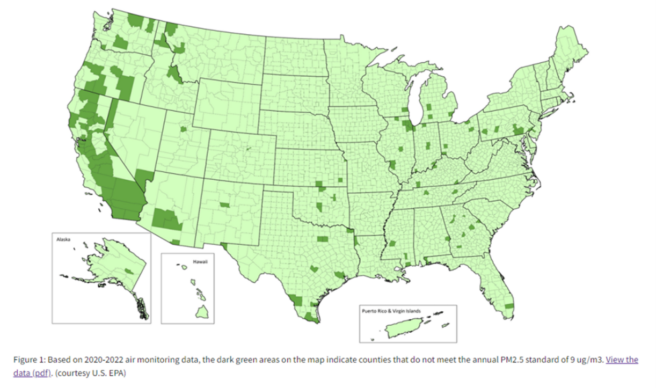
In Louisiana, Caddo Parish and West Baton Rouge Parish, with design values of 9.6 µg/m3 and 9.1 µg/m3, respectively, would not meet the PM2.5 NAAQS of 9 µg/m3. However, Louisiana’s Department of Environmental Quality has submitted two “exceptional event”1 demonstrations to the EPA for consideration, both dealing with the Port Allen monitoring station in West Baton Rouge Parish. The events included a Saharan Dust that resulted in 5 days of elevated PM2.5 levels in June 2022 and a Canadian Wildfire Smoke that resulted in 2 days of PM2.5 exceedances in October 2023. Removal of these “exceptional events” would result in West Baton Rouge Parish meeting the PM2.5 NAAQS of 9 µg/m3.

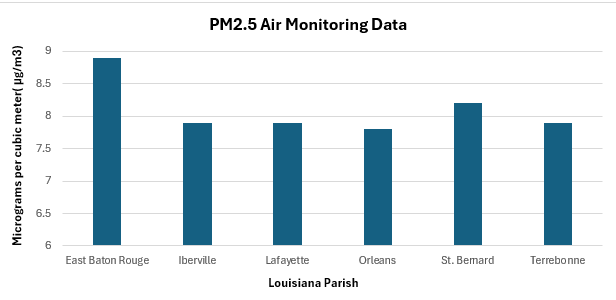
In addition to the areas that would likely be in non-attainment, there are also numerous areas that would be very close to exceeding the standard, which would severely limit growth and development in those areas. In Louisiana specifically, the following parishes have design values that are approaching the 9 µg/m3 standard:
Litigation Challenging Final Rule Tightening PM2.5 NAAQS

OnMarch 6, 2024, a group of states, including Louisiana, and other industry groups filed petitions for judicial review in the D.C. Circuit, requesting the court to vacate EPA’s rule tightening the PM2.5 NAAQS. See Commonwealth of Kentucky et al. v. EPA et al., No. 24-1050 (D.C. Cir. Mar. 6, 2024). The industry groups and states claimed that EPA acted in a manner contrary to law by improperly undertaking a discretionary, non-statutory reconsideration of the PM2.5 NAAQS, rather than a statutorily-mandated review under CAA § 109(d) (i.e., five-year review), and failing to adequately consider all required and relevant factors, including costs, in making its decision. Oral argument was held on December 16, 2024. Most recently, on February 25, 2025, the D.C. Circuit granted EPA’s motion to hold the case in abeyance for 60 days to allow new EPA leadership to review the PM2.5 NAAQS.

Reconsideration of PM2.5 NAAQS

In connection with the agency’s March 12, 2025, announcement to reconsider the PM2.5 NAAQS, EPA Administrator Zeldin noted that the previous administration’s PM2.5 NAAQS raised serious concerns from states and served as a major obstacle to permitting. “Under President Trump, we will ensure air quality standards for particulate matter are protective of human health and the environment while we unleash the Golden Age of American prosperity,” said Zeldin. It is important to note that any attempt by EPA to revise the previous administration’s PM2.5 NAAQS will be subject to the formal rulemaking process, including notice and comment periods.

In addition to a reconsideration of the PM2.5 NAAQS, EPA announced that “it will soon release guidance to increase flexibility on NAAQS implementation, reforms to New Source Review, and direction on permitting obligations.”

Stay tuned for further developments. Liskow will be monitoring and covering further actions regarding the new administration’s reconsideration of the PM2.5 NAAQS on Liskow’s The Louisiana Industrial Insights Hub. For more information on industry impacts and opportunities arising under the new administration, please contact Liskow attorneys Greg Johnson, Clare Bienvenu, and Colin North.


1One of EPA’s 31 historic deregulatory actions includes a reconsideration of its Exceptional Events Rule.

Blogs

FinCEN Removes Beneficial Ownership Reporting Requirements for U.S. Companies and Persons

March 21, 2025less than a minute

FinCEN announced an interim final rule on March 21, 2025 that removes both United States companies, regardless of ownership,  and United States persons from the definition of Reporting Companies required to file a Corporate Transparency Act Beneficial Ownership Information (“BOI”) Report . Under the new rule, “Reporting Company” means only those entities “that are formed under the law of a foreign country and that have registered to do business in any U.S. State or Tribal jurisdiction by the filing of a document with a secretary of state or similar office.” Entities previously known as “domestic reporting companies” no longer have to file a BOI Report.

For foreign reporting companies, entities will no longer be required to report on information about  U.S. persons who are  beneficial owners and U.S. persons will not be required to report BOI with respect to any such entity for which they are a beneficial owner. Once the rule is published, foreign entities will be required to file their report as follows:

  • Reporting companies registered to do business in the United States before the date of publication of the interim final rule must file BOI reports no later than 30 days from that date.
  • Reporting companies registered to do business in the United States on or after the date of publication of the interim final rule have 30 calendar days to file an initial BOI report after receiving notice that their registration is effective.

FinCEN plans to accept comments on the interim final rule and publish later this year. We will provide further updates about the status of the BOI reporting deadline as they become available. For further questions regarding the update, contact Liskow attorneys Leon Rittenberg III, Julie Chauvin, Marilyn Maloney, Caroline Lafourcade , John Rouchell or Kevin Naccari, Jr. and visit our Tax Practice page.

Blogs

FinCEN Removes Beneficial Ownership Reporting Requirements for U.S. Companies and Persons

March 21, 20252 minute read

FinCEN announced an interim final rule on March 21, 2025 that removes both United States companies, regardless of ownership,  and United States persons from the definition of Reporting Companies required to file a Corporate Transparency Act Beneficial Ownership Information (“BOI”) Report . Under the new rule, “Reporting Company” means only those entities “that are formed under the law of a foreign country and that have registered to do business in any U.S. State or Tribal jurisdiction by the filing of a document with a secretary of state or similar office.” Entities previously known as “domestic reporting companies” no longer have to file a BOI Report.

For foreign reporting companies, entities will no longer be required to report on information about  U.S. persons who are  beneficial owners and U.S. persons will not be required to report BOI with respect to any such entity for which they are a beneficial owner. Once the rule is published, foreign entities will be required to file their report as follows:

  • Reporting companies registered to do business in the United States before the date of publication of the interim final rule must file BOI reports no later than 30 days from that date.
  • Reporting companies registered to do business in the United States on or after the date of publication of the interim final rule have 30 calendar days to file an initial BOI report after receiving notice that their registration is effective.

FinCEN plans to accept comments on the interim final rule and publish later this year. We will provide further updates about the status of the BOI reporting deadline as they become available. For further questions regarding the update, contact Liskow attorneys Leon Rittenberg III, Julie Chauvin, Marilyn Maloney, Caroline Lafourcade , John Rouchell or Kevin Naccari, Jr. and visit our Tax Practice page.

Blogs

Louisiana State and Local Tax Update – March 29th Ballot on Constitutional Amendments to Proceed

March 20, 2025less than a minute

On Tuesday, the Louisiana Supreme Court rejected an attempt to block a constitutional amendment needed to complete the restructuring of the state’s tax laws sought by Gov. Jeff Landry and the Louisiana Legislature. The Court allowed to move forward a statewide vote on a package of changes to the state’s tax laws by dismissing a case challenging how the reforms were presented to voters.

Among other substantive changes, the amendment would remove the cap that limits how much in severance tax revenue local governments can receive from the state for oil, gas and other mineral activity on their lands.  The amendment also would require a portion of the money generated from the severance tax on certain types of brine to be paid to parishes.

While folks at the Capitol are focused on the March 29th ballot, Louisiana taxpayers should expect the Legislature to revisit some of the measures that were enacted during last year’s special session in the upcoming fiscal session which starts in April.

Lawmakers are expected to make an attempt to lower severance taxes on oil. Currently, the state’s horizontal well exemption spares much of the natural gas production from taxation; limiting that exemption could allow the Legislature to pay for a lower rate on oil.  

Read the full post on Liskow’s Gulf Coast Business Law Blog here.

Blogs

Louisiana State and Local Tax Update – March 29th Ballot on Constitutional Amendments to Proceed

March 20, 2025less than a minute

Featured Image


On Tuesday, the Louisiana Supreme Court rejected an attempt to block a constitutional amendment needed to complete the restructuring of the state’s tax laws sought by Gov. Jeff Landry and the Louisiana Legislature. The Court allowed to move forward a statewide vote on a package of changes to the state’s tax laws by dismissing a case challenging how the reforms were presented to voters.

Among other substantive changes, the amendment would remove the cap that limits how much in severance tax revenue local governments can receive from the state for oil, gas and other mineral activity on their lands.  The amendment also would require a portion of the money generated from the severance tax on certain types of brine to be paid to parishes.

While folks at the Capitol are focused on the March 29th ballot, Louisiana taxpayers should expect the Legislature to revisit some of the measures that were enacted during last year’s special session in the upcoming fiscal session which starts in April.

Lawmakers are expected to make an attempt to lower severance taxes on oil. Currently, the state’s horizontal well exemption spares much of the natural gas production from taxation; limiting that exemption could allow the Legislature to pay for a lower rate on oil.  

Read the full post on Liskow’s Gulf Coast Business Law Blog here.

Blogs

Louisiana State and Local Tax Update – March 29th Ballot on Constitutional Amendments to Proceed

March 20, 20252 minute read

On Tuesday, the Louisiana Supreme Court rejected an attempt to block a constitutional amendment needed to complete the restructuring of the state’s tax laws sought by Gov. Jeff Landry and the Louisiana Legislature. The Court allowed to move forward a statewide vote on a package of changes to the state’s tax laws by dismissing a case challenging how the reforms were presented to voters.

Amendment 2, one of four amendments voters across the state are considering on the March 29th ballot, would make changes to provisions of the state constitution that govern taxes and government spending.  The other amendments involve debt payments, specialized courts, juvenile crime and vacancies in judgeships.

The four amendments were passed by lawmakers in a special legislative session in November. The House and Senate created a special statewide election to consider these amendments. Each proposal had to receive a two-third favorable vote in the House and Senate to reach the ballot. Now, each amendment needs a majority vote at the polls to get enacted.

While folks at the Capitol are focused on the March 29th ballot, Louisiana taxpayers should expect the Legislature to revisit some of the measures that were enacted during last year’s special session in the upcoming fiscal session which starts in April.

One item expected to be addressed in a cleanup bill will be reinstating vendor compensation, which is the cut of sales taxes that businesses get to keep, for local sales tax collections. In addition, lawmakers plan to clarify that K-12 schools and nonprofits don’t have to collect sales taxes for sports tickets and events, an issue Revenue Secretary Richard Nelson addressed in Revenue Information Bulletin No. 25-009 earlier this year. 

It is also expected that the Legislature will reconsider the incentives the state is offering to entice local governments to forgo charging the inventory tax, an option the locals will have if the amendment passes. Lawmakers approved upfront payments for parishes, based on how much inventory tax they collect, but failed to include totals collected at the municipal level.   If Amendment 2 passes, some dollars that have been flowing into two state trust funds will be available for general spending. It has been suggested by legislators that some of that money could be used to enhance payments to local governments that choose to give up inventory taxes. 

Secretary Nelson has noted that there might be some appetite for a “limited services sales tax bill” although the move to expand the sales tax base to include more services was controversial. 

Lawmakers are also expected to make an attempt to lower severance taxes on oil. Currently, the state’s horizontal well exemption spares much of the natural gas production from taxation; limiting that exemption could allow the Legislature to pay for a lower rate on oil.  

If Amendment 2 passes on March 29th, enacting a new exemption, exclusion, deduction, credit or rebate will take a two-thirds vote, rather than a simple majority in the Legislature.

For further questions regarding this update, contact Liskow attorneys Bob Angelico, Caroline Lafourcade, and Kevin Naccari, Jr., and visit our Tax practice page.

Blogs

Louisiana State and Local Tax Update – March 29th Ballot on Constitutional Amendments to Proceed

March 20, 20252 minute read

On Tuesday, the Louisiana Supreme Court rejected an attempt to block a constitutional amendment needed to complete the restructuring of the state’s tax laws sought by Gov. Jeff Landry and the Louisiana Legislature. The Court allowed to move forward a statewide vote on a package of changes to the state’s tax laws by dismissing a case challenging how the reforms were presented to voters.

Amendment 2, one of four amendments voters across the state are considering on the March 29th ballot, would make changes to provisions of the state constitution that govern taxes and government spending.  The other amendments involve debt payments, specialized courts, juvenile crime and vacancies in judgeships.

The four amendments were passed by lawmakers in a special legislative session in November. The House and Senate created a special statewide election to consider these amendments. Each proposal had to receive a two-third favorable vote in the House and Senate to reach the ballot. Now, each amendment needs a majority vote at the polls to get enacted.

While folks at the Capitol are focused on the March 29th ballot, Louisiana taxpayers should expect the Legislature to revisit some of the measures that were enacted during last year’s special session in the upcoming fiscal session which starts in April.

One item expected to be addressed in a cleanup bill will be reinstating vendor compensation, which is the cut of sales taxes that businesses get to keep, for local sales tax collections. In addition, lawmakers plan to clarify that K-12 schools and nonprofits don’t have to collect sales taxes for sports tickets and events, an issue Revenue Secretary Richard Nelson addressed in Revenue Information Bulletin No. 25-009 earlier this year. 

It is also expected that the Legislature will reconsider the incentives the state is offering to entice local governments to forgo charging the inventory tax, an option the locals will have if the amendment passes. Lawmakers approved upfront payments for parishes, based on how much inventory tax they collect, but failed to include totals collected at the municipal level.   If Amendment 2 passes, some dollars that have been flowing into two state trust funds will be available for general spending. It has been suggested by legislators that some of that money could be used to enhance payments to local governments that choose to give up inventory taxes. 

Secretary Nelson has noted that there might be some appetite for a “limited services sales tax bill” although the move to expand the sales tax base to include more services was controversial. 

Lawmakers are also expected to make an attempt to lower severance taxes on oil. Currently, the state’s horizontal well exemption spares much of the natural gas production from taxation; limiting that exemption could allow the Legislature to pay for a lower rate on oil.  

If Amendment 2 passes on March 29th, enacting a new exemption, exclusion, deduction, credit or rebate will take a two-thirds vote, rather than a simple majority in the Legislature.

For further questions regarding this update, contact Liskow attorneys Bob Angelico, Caroline Lafourcade, and Kevin Naccari, Jr., and visit our Tax practice page.

Blogs

Louisiana State and Local Tax Update – March 29th Ballot on Constitutional Amendments to Proceed

March 20, 2025less than a minute

Featured Image

On Tuesday, the Louisiana Supreme Court rejected an attempt to block a constitutional amendment needed to complete the restructuring of the state’s tax laws sought by Gov. Jeff Landry and the Louisiana Legislature. The Court allowed to move forward a statewide vote on a package of changes to the state’s tax laws by dismissing a case challenging how the reforms were presented to voters.

Among other substantive changes, the amendment would remove the cap that limits how much in severance tax revenue local governments can receive from the state for oil, gas and other mineral activity on their lands.  The amendment also would require a portion of the money generated from the severance tax on certain types of brine to be paid to parishes.

While folks at the Capitol are focused on the March 29th ballot, Louisiana taxpayers should expect the Legislature to revisit some of the measures that were enacted during last year’s special session in the upcoming fiscal session which starts in April.

Lawmakers are expected to make an attempt to lower severance taxes on oil. Currently, the state’s horizontal well exemption spares much of the natural gas production from taxation; limiting that exemption could allow the Legislature to pay for a lower rate on oil.  

Read the full post on Liskow’s Gulf Coast Business Law Blog here.

Blogs

EPA Announces 31 Historic Actions Publicized as “Greatest Day of Deregulation Our Nation Has Seen”

March 17, 20253 minute read

On March 12, 2025, EPA Administrator Zeldin announced that the agency will undertake 31 deregulatory actions to advance President Trump’s Day One executive orders and EPA’s “Powering the Great American Comeback.” Below is a list of the actions with hyperlinks that include background information and additional detail on the specific action:

UNLEASHING AMERICAN ENERGY  

  • Reconsideration of regulations on power plants (Clean Power Plan 2.0) 
  • Reconsideration of air regulations throttling the oil and gas industry (OOOO b/c) 
  • Reconsideration of Mercury and Air Toxics Standards that improperly targeted coal-fired power plants (MATS) 
  • Reconsideration of mandatory Greenhouse Gas Reporting Program that imposed significant costs on the American energy supply (GHG Reporting Program) 
  • Reconsideration of water effluent limitations, guidelines and standards (ELG) for the Steam Electric Power Generating Industry to ensure low-cost electricity while protecting water resources (Steam Electric ELG) 
  • Reconsideration of wastewater regulations for oil and gas development to help unleash American energy (Oil and Gas ELG) 
  • Reconsideration of Biden-Harris Administration Risk Management Program rule that made America’s oil and natural gas refineries and chemical facilities less safe (Risk Management Program Rule) 

LOWERING THE COST OF LIVING FOR AMERICAN FAMILIES 

  • Reconsideration of light-duty, medium-duty, and heavy-duty vehicle regulations that provided the foundation for the Biden-Harris electric vehicle mandate (Car GHG Rules) 
  • Reconsideration of the 2009 Endangerment Finding and regulations and actions that rely on that Finding (Endangerment Finding) 
  • Reconsideration of the technology transition rule that forces companies to use certain technologies that increased costs on food at grocery stores and semiconductor manufacturing (Technology Transition Rule) 
  • Reconsideration of Particulate Matter National Ambient Air Quality Standards that shut down opportunities for American manufacturing and small businesses (PM 2.5 NAAQS) 
  • Reconsideration of multiple National Emission Standards for Hazardous Air Pollutants for American energy and manufacturing sectors (NESHAPs) 
  • Restructuring the Regional Haze Program that threatened the supply of affordable energy for American families (Regional Haze) 
  • Overhauling the Biden-Harris Administration’s “Social Cost of Carbon” 
  • Redirecting enforcement resources to EPA’s core mission, with the aim of relieving the economy of unnecessary bureaucratic burdens that drive up costs for American consumers (Enforcement Discretion) 
  • Terminating Biden’s Environmental Justice and DEI arms of EPA (EJ/DEI) 

ADVANCING COOPERATIVE FEDERALISM  

  • Ending so-called “Good Neighbor Plan” which the Biden-Harris Administration used to expand federal rules to more states and sectors beyond the program’s traditional focus and led to the rejection of nearly all State Implementation Plans 
  • Working with states and tribes to resolve massive backlog with State Implementation Plans and Tribal Implementation Plans that the Biden-Harris Administration refused to resolve (SIPs/TIPs) 
  • Reconsideration of exceptional events rulemaking to work with states to prioritize the allowance of prescribed fires within State and Tribal Implementation Plans (Exceptional Events) 
  • Reconstituting the Science Advisory Board and the Clean Air Scientific Advisory Committee (SAB/CASAC) 
  • Prioritizing the coal ash program to expedite state permit reviews and update coal ash regulations (CCR Rule) 
  • Utilizing enforcement discretion to further North Carolina’s recovery from Hurricane Helene 

Many of these actions target promulgated regulations, so any effort to revise them will be subject to the formal rulemaking process, including notice and comment periods, and will likely face legal challenges. Industry should remain alert for developments associated with these actions. Liskow will be monitoring and covering further actions regarding the new administration’s deregulatory push on Liskow’s The Louisiana Industrial Insights Hub. For more information on industry impacts and opportunities arising under the new administration, please contact Liskow attorneys Greg Johnson, Clare Bienvenu, and Colin North.

Blogs

EPA Announces 31 Historic Actions Publicized as “Greatest Day of Deregulation Our Nation Has Seen”

March 17, 20253 minute read

Featured Image


On March 12, 2025, EPA Administrator Zeldin announced that the agency will undertake 31 deregulatory actions to advance President Trump’s Day One executive orders and EPA’s “Powering the Great American Comeback.” Below is a list of the actions with hyperlinks that include background information and additional detail on the specific action:

UNLEASHING AMERICAN ENERGY  

  • Reconsideration of regulations on power plants (Clean Power Plan 2.0)
  • Reconsideration of air regulations throttling the oil and gas industry (OOOO b/c)
  • Reconsideration of Mercury and Air Toxics Standards that improperly targeted coal-fired power plants (MATS)
  • Reconsideration of mandatory Greenhouse Gas Reporting Program that imposed significant costs on the American energy supply (GHG Reporting Program)
  • Reconsideration of water effluent limitations, guidelines and standards (ELG) for the Steam Electric Power Generating Industry to ensure low-cost electricity while protecting water resources (Steam Electric ELG)
  • Reconsideration of wastewater regulations for oil and gas development to help unleash American energy (Oil and Gas ELG)
  • Reconsideration of Biden-Harris Administration Risk Management Program rule that made America’s oil and natural gas refineries and chemical facilities less safe (Risk Management Program Rule) 

LOWERING THE COST OF LIVING FOR AMERICAN FAMILIES 

  • Reconsideration of light-duty, medium-duty, and heavy-duty vehicle regulations that provided the foundation for the Biden-Harris electric vehicle mandate (Car GHG Rules)
  • Reconsideration of the 2009 Endangerment Finding and regulations and actions that rely on that Finding (Endangerment Finding)
  • Reconsideration of the technology transition rule that forces companies to use certain technologies that increased costs on food at grocery stores and semiconductor manufacturing (Technology Transition Rule)
  • Reconsideration of Particulate Matter National Ambient Air Quality Standards that shut down opportunities for American manufacturing and small businesses (PM 2.5 NAAQS)
  • Reconsideration of multiple National Emission Standards for Hazardous Air Pollutants for American energy and manufacturing sectors (NESHAPs)
  • Restructuring the Regional Haze Program that threatened the supply of affordable energy for American families (Regional Haze)
  • Overhauling the Biden-Harris Administration’s “Social Cost of Carbon”
  • Redirecting enforcement resources to EPA’s core mission, with the aim of relieving the economy of unnecessary bureaucratic burdens that drive up costs for American consumers (Enforcement Discretion)
  • Terminating Biden’s Environmental Justice and DEI arms of EPA (EJ/DEI) 

ADVANCING COOPERATIVE FEDERALISM  

  • Ending so-called “Good Neighbor Plan” which the Biden-Harris Administration used to expand federal rules to more states and sectors beyond the program’s traditional focus and led to the rejection of nearly all State Implementation Plans
  • Working with states and tribes to resolve massive backlog with State Implementation Plans and Tribal Implementation Plans that the Biden-Harris Administration refused to resolve (SIPs/TIPs)
  • Reconsideration of exceptional events rulemaking to work with states to prioritize the allowance of prescribed fires within State and Tribal Implementation Plans (Exceptional Events)
  • Reconstituting the Science Advisory Board and the Clean Air Scientific Advisory Committee (SAB/CASAC)
  • Prioritizing the coal ash program to expedite state permit reviews and update coal ash regulations (CCR Rule)
  • Utilizing enforcement discretion to further North Carolina’s recovery from Hurricane Helene 

Many of these actions target promulgated regulations, so any effort to revise them will be subject to the formal rulemaking process, including notice and comment periods, and will likely face legal challenges. Industry should remain alert for developments associated with these actions. Liskow will be monitoring and covering further actions regarding the new administration’s deregulatory push on Liskow’s The Louisiana Industrial Insights Hub. For more information on industry impacts and opportunities arising under the new administration, please contact Liskow attorneys Greg Johnson, Clare Bienvenu, and Colin North.

Blogs

  • « Go to Previous Page
  • Page 1
  • Interim pages omitted …
  • Page 30
  • Page 31
  • Page 32
  • Page 33
  • Page 34
  • Interim pages omitted …
  • Page 185
  • Go to Next Page »

Primary Sidebar

Recent Posts

  • Louisiana Makes DOE’s Nuclear Shortlist
  • Louisiana Rewrites the Rules of Getting Paid: What Act 822 of 2026 Means for Companies Involved in Industrial Construction
  • House Advances Sweeping Maritime Reforms in FY27 Defense Bill
  • Establishment of the Marine Minerals Administration
  • The Foundation for Natural Resources and Energy Law Elects Jana Grauberger as President

Categories

  • Blogs
  • Events
  • Insights
  • News
Liskow & Lewis, APLC
Arrow Icon

future-focused

  • Baton Rouge
  • Houston
  • Lafayette
  • New Orleans
  • New York City
  • © 2026 Liskow & Lewis, APLC
  • Sitemap
  • Disclaimer
  • Employee Login
Site by
We use cookies on our website to give you the most relevant experience by remembering your preferences and repeat visits. By clicking “Accept All”, you consent to the use of ALL the cookies. However, you may visit "Cookie Settings" to provide a controlled consent.
Cookie SettingsAccept All
Manage consent

Privacy Overview

This website uses cookies to improve your experience while you navigate through the website. Out of these, the cookies that are categorized as necessary are stored on your browser as they are essential for the working of basic functionalities of the website. We also use third-party cookies that help us analyze and understand how you use this website. These cookies will be stored in your browser only with your consent. You also have the option to opt-out of these cookies. But opting out of some of these cookies may affect your browsing experience.
Necessary
Always Enabled
Necessary cookies are absolutely essential for the website to function properly. These cookies ensure basic functionalities and security features of the website, anonymously.
CookieDurationDescription
cookielawinfo-checkbox-analytics11 monthsThis cookie is set by GDPR Cookie Consent plugin. The cookie is used to store the user consent for the cookies in the category "Analytics".
cookielawinfo-checkbox-functional11 monthsThe cookie is set by GDPR cookie consent to record the user consent for the cookies in the category "Functional".
cookielawinfo-checkbox-necessary11 monthsThis cookie is set by GDPR Cookie Consent plugin. The cookies is used to store the user consent for the cookies in the category "Necessary".
cookielawinfo-checkbox-others11 monthsThis cookie is set by GDPR Cookie Consent plugin. The cookie is used to store the user consent for the cookies in the category "Other.
cookielawinfo-checkbox-performance11 monthsThis cookie is set by GDPR Cookie Consent plugin. The cookie is used to store the user consent for the cookies in the category "Performance".
viewed_cookie_policy11 monthsThe cookie is set by the GDPR Cookie Consent plugin and is used to store whether or not user has consented to the use of cookies. It does not store any personal data.
Functional
Functional cookies help to perform certain functionalities like sharing the content of the website on social media platforms, collect feedbacks, and other third-party features.
Performance
Performance cookies are used to understand and analyze the key performance indexes of the website which helps in delivering a better user experience for the visitors.
Analytics
Analytical cookies are used to understand how visitors interact with the website. These cookies help provide information on metrics the number of visitors, bounce rate, traffic source, etc.
Advertisement
Advertisement cookies are used to provide visitors with relevant ads and marketing campaigns. These cookies track visitors across websites and collect information to provide customized ads.
Others
Other uncategorized cookies are those that are being analyzed and have not been classified into a category as yet.
SAVE & ACCEPT
  • Team
  • Practices
  • Insights
  • Blogs
  • Offices
  • Pro Bono
  • About Us
  • Careers
  • DEI
  • The Energy Law Blog
  • Gulf Coast Business Law Blog
  • The Maritime Law Blog