
• Skip to content
  • Skip to primary sidebar

liskow_lewis_white_new

future-focused

  • Team
  • Practices
  • Insights
  • Blogs
    • Energy Law Blog
    • Gulf Coast Business Law Blog
    • Maritime Law Blog
    • Louisiana Industrial Insights Hub

Blogs

LDR Clarifies Sales and Use Tax Treatment for the Rental of Equipment with an Operator

April 7, 20253 minute read

On April 3, 2025, the Louisiana Department of Revenue published Revenue Information Bulletin No. 25-013 clarifying the proper sales and use tax treatment for rentals of cranes and other equipment with operators. Under Act 11 of the Third Extraordinary Session of 2024, the Louisiana Legislature repealed the statutory sales and use tax exclusion for the lease or rental of cranes and related equipment with operators. However, R.I.B. No. 25-013 makes clear that this repeal does not mean that all leases of cranes and other related equipment are taxable. The lease or rental of a crane and related equipment with an operator will  be treated the same as other rentals of tangible personal property with operators for sales and use tax purposes.

Whether a lease or rental of tangible personal property, including cranes and related equipment, with an operator is subject to sales and use tax is determined based on whether the “essence of the transaction” is the performance of a service (not taxable) or the lease of tangible personal property (taxable).  The taxability of such transactions is determined by following the analysis provided in LAC 61:I.4301 “Lease or Rental (c)(i) and (ii). That regulation provides that:

i.  A lease or rental does not include providing tangible personal property with an operator who provides some additional service for a fixed or indeterminate period of time when the essence of the transaction is the performance of a service. The essence of the transaction is to provide a service when obtaining the tangible personal property is not an end in and of itself but rather furnishes the mechanism through which a service is provided.

ii. In order to determine the essence of a transaction involving both the performance of a service and the providing of tangible personal property, the facts and circumstances of each transaction must be examined. The following factors suggest, but are not necessarily conclusive, that the essence of the transaction is for the performance of a service:

(a) in order for the tangible personal property to perform as designed, the owner’s operator maintains control over the property. This level of control by the owner’s operator involves more than maintaining, inspecting, or setting-up the property;

(b) the contract between the owner of the property and the person receiving the services and property provides for the performance of a specific job that requires services for a certain number of hours or until completion of a specific job; 

(c) the performance of the job using the tangible personal property is conducted in a manner determined by the owner of the property;

(d) the owner of the tangible personal property is responsible for choosing the particular piece of property to be used in the transaction; or

(e) the owner of the tangible personal property has a standard business practice of not allowing customers to rent the property separately from the services provided.

The R.I.B. makes clear that the regulation for the lease or rental of tangible personal property with an operator will also apply to the lease or rental of cranes and other related equipment. “If the facts and circumstances indicate the essence of the transaction is the performance of a service, the lease or rental of a crane with an operator will be treated as a non-taxable service.”

For further questions regarding this update, please contact Liskow attorneys Bob Angelico, Caroline Lafourcade, or Kevin Naccari and visit our Tax practice page and The Louisiana Industrial Insights Hub for further updates.

Blogs

CCS Update: Hackberry Carbon Sequestration, LLC Receives Draft Permit for Class VI Well in Cameron Parish

April 4, 20252 minute read

On April 3, 2025, the Louisiana Department of Energy and Natural Resources (LDENR), Office of Conservation, issued a Draft Permit prepared by the Injection and Mining Division for Hackberry Carbon Sequestration, LLC (HCS) to drill, construct, and operate a Class VI injection well for geologic sequestration of carbon dioxide in Cameron Parish, Louisiana (See ORDER NO. IMD 2025-04 GS). The draft permit is the first issued by LDENR since the agency was granted primacy over the Class VI permitting program.

HCS submitted its application to the LDENR on February 5, 2024, for the drilling and operation of one Class VI injection well in Section 12, Township 12 South, Range 11 West, of Cameron Parish, with a total proposed depth of approximately 10,100 feet below ground level. The base of the lowermost underground source of drinking water at this location occurs at approximately 1,090 feet below ground level, and there are no registered water wells within one mile. In its application, HCS proposes to inject and permanently sequester approximately 2 million metric tons of carbon dioxide per year for an estimated 20 years sourced from Cameron LNG, LLC’s liquified natural gas export facility.

Pursuant to a public notice issued in conjunction with the Draft Permit, the comment period, a timeframe during which interested parties may submit written feedback to the LDENR regarding the Draft Permit, extends from April 3, 2025, to May 6, 2025. After the conclusion of this public comment period, the Office of Conservation will then respond to all relevant comments in a written report. Additionally, the Office of Conservation will hold a public hearing on May 5, 2025, at 6:00 p.m. at the Hackberry Community Center to hear testimony, facts, and oral and written comments related to the Draft Permit.

If issued, the HCA permit will be the first Class VI well permitted in Louisiana since primacy was granted to the state by the EPA in December of 2023. It is important to note, however, that the EPA’s decision to grant Louisiana primacy over the permitting of Class VI wells is the subject of ongoing litigation in the United States Court of Appeals for the Fifth Circuit, where environmental groups have asked the court to vacate the delegation of the program. The outcome of this litigation could affect the LDENR’s authority to issue a final permit for HCS to drill, construct, and operate its proposed Class VI injection well. Stay tuned for further updates on the ongoing litigation in the Fifth Circuit and the LDENR’s decision on HCS’s Class VI injection well application.

Contact Liskow attorney Jeff Lieberman for further questions regarding this update. For further information, visit our CCS practice page and follow along The Louisiana Industrial Insights Hub.

Blogs

CCS Update: Hackberry Carbon Sequestration, LLC Receives Draft Permit for Class VI Well in Cameron Parish

April 4, 20252 minute read

On April 3, 2025, the Louisiana Department of Energy and Natural Resources (LDENR), Office of Conservation, issued a Draft Permit prepared by the Injection and Mining Division for Hackberry Carbon Sequestration, LLC (HCS) to drill, construct, and operate a Class VI injection well for geologic sequestration of carbon dioxide in Cameron Parish, Louisiana (See ORDER NO. IMD 2025-04 GS). The draft permit is the first issued by LDENR since the agency was granted primacy over the Class VI permitting program.

HCS submitted its application to the LDENR on February 5, 2024, for the drilling and operation of one Class VI injection well in Section 12, Township 12 South, Range 11 West, of Cameron Parish, with a total proposed depth of approximately 10,100 feet below ground level. The base of the lowermost underground source of drinking water at this location occurs at approximately 1,090 feet below ground level, and there are no registered water wells within one mile. In its application, HCS proposes to inject and permanently sequester approximately 2 million metric tons of carbon dioxide per year for an estimated 20 years sourced from Cameron LNG, LLC’s liquified natural gas export facility.

Pursuant to a public notice issued in conjunction with the Draft Permit, the comment period, a timeframe during which interested parties may submit written feedback to the LDENR regarding the Draft Permit, extends from April 3, 2025, to May 6, 2025. After the conclusion of this public comment period, the Office of Conservation will then respond to all relevant comments in a written report. Additionally, the Office of Conservation will hold a public hearing on May 5, 2025, at 6:00 p.m. at the Hackberry Community Center to hear testimony, facts, and oral and written comments related to the Draft Permit.

If issued, the HCA permit will be the first Class VI well permitted in Louisiana since primacy was granted to the state by the EPA in December of 2023. It is important to note, however, that the EPA’s decision to grant Louisiana primacy over the permitting of Class VI wells is the subject of ongoing litigation in the United States Court of Appeals for the Fifth Circuit, where environmental groups have asked the court to vacate the delegation of the program. The outcome of this litigation could affect the LDENR’s authority to issue a final permit for HCS to drill, construct, and operate its proposed Class VI injection well. Stay tuned for further updates on the ongoing litigation in the Fifth Circuit and the LDENR’s decision on HCS’s Class VI injection well application.

Contact Liskow attorney Jeff Lieberman for further questions regarding this update. For further information, visit our CCS practice page and follow along The Louisiana Industrial Insights Hub.

Blogs

Podcast: Pipelines and Protests: The Greenpeace Verdict

April 2, 2025less than a minute

On this week’s episode of “Energy Law This Week,” hosts Matt Jones and April Rolen-Ogden discuss the significant legal case involving Greenpeace and Energy Transfer regarding the Dakota Access Pipeline protests. The conversation delves into the $660 million verdict against Greenpeace, the implications for free speech, the financial aspects of the case, and the role of the Standing Rock Sioux Tribe. The hosts also explore the venue of the trial, the potential for SLAPP laws, and provide practical tips for legal practitioners. Overall, the case is positioned as a pivotal moment in energy law and environmental activism.

Listen to the full episode on the Oil & Gas Global Network here.

Blogs

Podcast: Pipelines and Protests: The Greenpeace Verdict

April 2, 2025less than a minute

On this week’s episode of “Energy Law This Week,” hosts Matt Jones and April Rolen-Ogden discuss the significant legal case involving Greenpeace and Energy Transfer regarding the Dakota Access Pipeline protests. The conversation delves into the $660 million verdict against Greenpeace, the implications for free speech, the financial aspects of the case, and the role of the Standing Rock Sioux Tribe. The hosts also explore the venue of the trial, the potential for SLAPP laws, and provide practical tips for legal practitioners. Overall, the case is positioned as a pivotal moment in energy law and environmental activism.

Listen to the full episode on the Oil & Gas Global Network here.

Blogs

Status of Tax Reform in Louisiana

March 31, 20252 minute read

While voters in Louisiana may have rejected all four of the constitutional amendments on Saturday’s ballot (the Secretary of State reported just over 21% voter turnout), including Amendment No. 2 which contained significant tax measures, efforts at tax reform are likely to resume during the Legislative Session that convenes next month.  Since the upcoming session will be “fiscal,” legislators are likely to remain focused on budgetary and tax-related matters.

The policy changes sought to be made by Amendment 2 included capping the individual income tax rate at 3.75% (currently the cap is 4.75%), creating tighter control on annual increases in state spending tied to state population changes and inflationary factors, and implementing a permanent teacher salary increase.  For now, Louisiana’s current income tax structure and spending limits remain intact. In addition, Saturday’s vote means no automatic tax deductions for seniors, no repeal of the property tax on business inventory, and no guaranteed teacher pay raises.

Amendment No. 2 also would have given parishes the option of repealing the property tax on business inventory (and an opportunity to get a one-time payment if inventory tax is irrevocably eliminated) and removed most property tax exemptions from the constitution (except for homestead and churches) placing their continued existence in the hands of legislators.  Enacting new property tax breaks would have been harder upon the passage of Amendment No. 2, as such action would have required a ¾ vote by the House and Senate.

The failure of constitutional Amendment No. 2 to pass does not directly affect the changes to Louisiana’s income tax rates or the repeal of the corporate franchise tax made during the special session last November.  Likewise, the broadening of the sales & use tax base to include sales of digital products, software as a service, and information services, and the elimination of numerous sales & use tax exemptions and exclusions that went into effect on January 1, 2025 were not contingent on the passage of any constitutional amendments.

Amendment No. 2 did contain a provision that would have brought Louisiana closer to uniformity with respect to state and local sales and use tax collection.  The amendment would have prohibited the legislative enactment of any new sales tax exclusion or exemption, unless it applies to both state and local sales taxes, starting January 1, 2026. 

And Amendment No. 2  would have removed a limit on the amount of funds local government could receive from severance taxes generated by oil, gas and other types of mineral production on land in their parishes. This would have increased payments to parishes and resulted in less money available to spend in the state budget.   

The Legislature is set to convene at noon on Monday, April 14, 2025, with Final Adjournment to be no later than 6:00 p.m. on Thursday, June 12, 2025.  Liskow’s tax lawyers will be following the Legislature during the upcoming fiscal session and monitoring Louisiana’s continued efforts at tax reform to retain and attract residents and business.

For further questions regarding this update, please contact Liskow attorneys Bob Angelico, Caroline Lafourcade, or Kevin Naccari and visit our Tax practice page.

Blogs

Status of Tax Reform in Louisiana

March 31, 20252 minute read

While voters in Louisiana may have rejected all four of the constitutional amendments on Saturday’s ballot (the Secretary of State reported just over 21% voter turnout), including Amendment No. 2 which contained significant tax measures, efforts at tax reform are likely to resume during the Legislative Session that convenes next month.  Since the upcoming session will be “fiscal,” legislators are likely to remain focused on budgetary and tax-related matters.

The policy changes sought to be made by Amendment 2 included capping the individual income tax rate at 3.75% (currently the cap is 4.75%), creating tighter control on annual increases in state spending tied to state population changes and inflationary factors, and implementing a permanent teacher salary increase.  For now, Louisiana’s current income tax structure and spending limits remain intact. In addition, Saturday’s vote means no automatic tax deductions for seniors, no repeal of the property tax on business inventory, and no guaranteed teacher pay raises.

Amendment No. 2 also would have given parishes the option of repealing the property tax on business inventory (and an opportunity to get a one-time payment if inventory tax is irrevocably eliminated) and removed most property tax exemptions from the constitution (except for homestead and churches) placing their continued existence in the hands of legislators.  Enacting new property tax breaks would have been harder upon the passage of Amendment No. 2, as such action would have required a ¾ vote by the House and Senate.

The failure of constitutional Amendment No. 2 to pass does not directly affect the changes to Louisiana’s income tax rates or the repeal of the corporate franchise tax made during the special session last November.  Likewise, the broadening of the sales & use tax base to include sales of digital products, software as a service, and information services, and the elimination of numerous sales & use tax exemptions and exclusions that went into effect on January 1, 2025 were not contingent on the passage of any constitutional amendments.

Amendment No. 2 did contain a provision that would have brought Louisiana closer to uniformity with respect to state and local sales and use tax collection.  The amendment would have prohibited the legislative enactment of any new sales tax exclusion or exemption, unless it applies to both state and local sales taxes, starting January 1, 2026. 

And Amendment No. 2  would have removed a limit on the amount of funds local government could receive from severance taxes generated by oil, gas and other types of mineral production on land in their parishes. This would have increased payments to parishes and resulted in less money available to spend in the state budget.   

The Legislature is set to convene at noon on Monday, April 14, 2025, with Final Adjournment to be no later than 6:00 p.m. on Thursday, June 12, 2025.  Liskow’s tax lawyers will be following the Legislature during the upcoming fiscal session and monitoring Louisiana’s continued efforts at tax reform to retain and attract residents and business.

For further questions regarding this update, please contact Liskow attorneys Bob Angelico, Caroline Lafourcade, or Kevin Naccari and visit our Tax practice page.

Blogs

Liskow Launches Energy Law Podcast on the Oil & Gas Global Network

March 26, 20252 minute read

Liskow is pleased to announce the launch of its “Energy Law This Week” podcast on the Oil & Gas Global Network (OGGN). Hosted by Liskow Shareholders Matt Jones and April Rolen-Odgen, the podcast provides insights at the intersection of law and energy focusing on the latest legal and regulatory developments shaping the energy sector.

Each episode takes on a core area of oil and gas law. The topic is legal, but the approach is broad based, aimed at all actors in the industry. “Law touches upon every facet of our industry,” said Matt Jones, an oil and gas trial lawyer with decades of experience. “Through candid conversations and real-world examples, we aim to provide valuable insights and enhance skill sets for all of our listeners, whatever their role in oil and gas.”

Liskow has been at the forefront of the energy industry for nearly a century, representing the full gamut of upstream, midstream, and downstream companies, from operators of all sizes to global energy giants. This experience will help guide discussions for each episode.

“Our institutional relationships and real-world experience have helped us develop a unique knowledge base of how our clients are structured internally and significant familiarity with their operations,” says April Rolen-Odgen, a first chair trial and appellate litigator for oil and gas companies. “We hope our listeners will come away from each episode informed and inspired to improve their operations.”

“I had no idea how many fascinating legal stories exist where oil and gas meets the law,” said Mark LaCour, Editor-in-chief of OGGN. “Known as a pioneer and industry leader in the energy sector, it makes sense to have Liskow on our network.”

The podcast is available for streaming and download on the OGGN platform, as well as major podcasting platforms such as Apple Podcasts, Spotify, and Google Podcasts.

Blogs

Liskow Launches Energy Law Podcast on the Oil & Gas Global Network

March 26, 20252 minute read

Liskow is pleased to announce the launch of its “Energy Law This Week” podcast on the Oil & Gas Global Network (OGGN). Hosted by Liskow Shareholders Matt Jones and April Rolen-Odgen, the podcast provides insights at the intersection of law and energy focusing on the latest legal and regulatory developments shaping the energy sector.

Each episode takes on a core area of oil and gas law. The topic is legal, but the approach is broad based, aimed at all actors in the industry. “Law touches upon every facet of our industry,” said Matt Jones, an oil and gas trial lawyer with decades of experience. “Through candid conversations and real-world examples, we aim to provide valuable insights and enhance skill sets for all of our listeners, whatever their role in oil and gas.”

Liskow has been at the forefront of the energy industry for nearly a century, representing the full gamut of upstream, midstream, and downstream companies, from operators of all sizes to global energy giants. This experience will help guide discussions for each episode.

“Our institutional relationships and real-world experience have helped us develop a unique knowledge base of how our clients are structured internally and significant familiarity with their operations,” says April Rolen-Odgen, a first chair trial and appellate litigator for oil and gas companies. “We hope our listeners will come away from each episode informed and inspired to improve their operations.”

“I had no idea how many fascinating legal stories exist where oil and gas meets the law,” said Mark LaCour, Editor-in-chief of OGGN. “Known as a pioneer and industry leader in the energy sector, it makes sense to have Liskow on our network.”

The podcast is available for streaming and download on the OGGN platform, as well as major podcasting platforms such as Apple Podcasts, Spotify, and Google Podcasts.

Blogs

EPA to Reconsider Previous Administration’s PM 2.5 NAAQS, Continuing its Deregulatory Push

March 25, 20253 minute read

On March 12, 2025, EPA Administrator Zeldin announced that the agency, as one of its 31 historic deregulatory actions to advance President Trump’s Day One executive orders and EPA’s “Powering the Great American Comeback,” will reconsider the previous administration’s rule tightening the Particulate Matter National Ambient Air Quality Standards (PM2.5 NAAQS). The PM2.5 NAAQS rule has raised implementation concerns from various states across the country, including Louisiana, and has been the subject of litigation in the U.S. Court of Appeals for the District of Columbia Circuit (D.C. Circuit).

Final Rule Tightening PM2.5 NAAQS

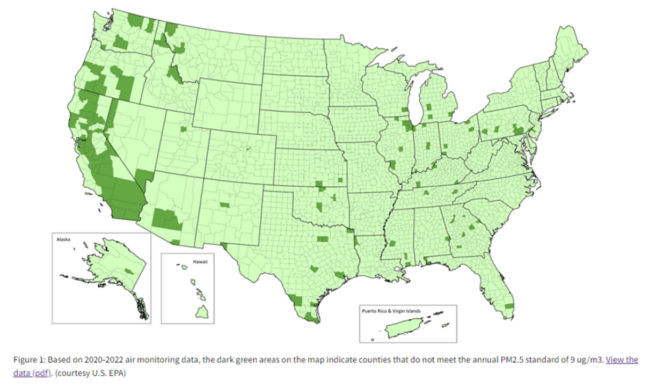
On March 6, 2024, EPA issued a final rule tightening the PM2.5 NAAQS, which set the primary (health-based) annual NAAQS for PM2.5 at 9 micrograms per cubic meter (µg/m3), down from the prior limit of 12 µg/m3. See 89 Fed. Reg. 16202 (Mar. 6, 2024). EPA also laid out its timetable for states and the agency to implement the tightened standards, with the first designations of areas of the country as meeting or violating the limit targeted for 2026 and compliance deadlines beginning in 2032. The new standards could result in many areas of the country being designated as nonattainment, triggering costly control requirements for facilities located in those new nonattainment areas. The map below depicts the counties/parishes that do not meet the annual PM2.5 NAAQS of 9 µg/m3 based on 2020-2022 air monitoring data.

In Louisiana, Caddo Parish and West Baton Rouge Parish, with design values of 9.6 µg/m3 and 9.1 µg/m3, respectively, would not meet the PM2.5 NAAQS of 9 µg/m3. However, Louisiana’s Department of Environmental Quality has submitted two “exceptional event”1 demonstrations to the EPA for consideration, both dealing with the Port Allen monitoring station in West Baton Rouge Parish. The events included a Saharan Dust that resulted in 5 days of elevated PM2.5 levels in June 2022 and a Canadian Wildfire Smoke that resulted in 2 days of PM2.5 exceedances in October 2023. Removal of these “exceptional events” would result in West Baton Rouge Parish meeting the PM2.5 NAAQS of 9 µg/m3.

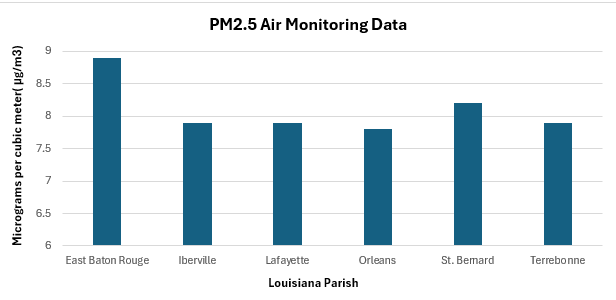
In addition to the areas that would likely be in non-attainment, there are also numerous areas that would be very close to exceeding the standard, which would severely limit growth and development in those areas. In Louisiana specifically, the following parishes have design values that are approaching the 9 µg/m3 standard:

Litigation Challenging Final Rule Tightening PM2.5 NAAQS

OnMarch 6, 2024, a group of states, including Louisiana, and other industry groups filed petitions for judicial review in the D.C. Circuit, requesting the court to vacate EPA’s rule tightening the PM2.5 NAAQS. See Commonwealth of Kentucky et al. v. EPA et al., No. 24-1050 (D.C. Cir. Mar. 6, 2024). The industry groups and states claimed that EPA acted in a manner contrary to law by improperly undertaking a discretionary, non-statutory reconsideration of the PM2.5 NAAQS, rather than a statutorily-mandated review under CAA § 109(d) (i.e., five-year review), and failing to adequately consider all required and relevant factors, including costs, in making its decision. Oral argument was held on December 16, 2024. Most recently, on February 25, 2025, the D.C. Circuit granted EPA’s motion to hold the case in abeyance for 60 days to allow new EPA leadership to review the PM2.5 NAAQS.

Reconsideration of PM2.5 NAAQS

In connection with the agency’s March 12, 2025, announcement to reconsider the PM2.5 NAAQS, EPA Administrator Zeldin noted that the previous administration’s PM2.5 NAAQS raised serious concerns from states and served as a major obstacle to permitting. “Under President Trump, we will ensure air quality standards for particulate matter are protective of human health and the environment while we unleash the Golden Age of American prosperity,” said Zeldin. It is important to note that any attempt by EPA to revise the previous administration’s PM2.5 NAAQS will be subject to the formal rulemaking process, including notice and comment periods.

In addition to a reconsideration of the PM2.5 NAAQS, EPA announced that “it will soon release guidance to increase flexibility on NAAQS implementation, reforms to New Source Review, and direction on permitting obligations.”

Stay tuned for further developments. Liskow will be monitoring and covering further actions regarding the new administration’s reconsideration of the PM2.5 NAAQS on Liskow’s The Louisiana Industrial Insights Hub. For more information on industry impacts and opportunities arising under the new administration, please contact Liskow attorneys Greg Johnson, Clare Bienvenu, and Colin North.


1One of EPA’s 31 historic deregulatory actions includes a reconsideration of its Exceptional Events Rule.

Blogs

  • « Go to Previous Page
  • Page 1
  • Interim pages omitted …
  • Page 29
  • Page 30
  • Page 31
  • Page 32
  • Page 33
  • Interim pages omitted …
  • Page 185
  • Go to Next Page »

Primary Sidebar

Recent Posts

  • Louisiana Makes DOE’s Nuclear Shortlist
  • Louisiana Rewrites the Rules of Getting Paid: What Act 822 of 2026 Means for Companies Involved in Industrial Construction
  • House Advances Sweeping Maritime Reforms in FY27 Defense Bill
  • Establishment of the Marine Minerals Administration
  • The Foundation for Natural Resources and Energy Law Elects Jana Grauberger as President

Categories

  • Blogs
  • Events
  • Insights
  • News
Liskow & Lewis, APLC
Arrow Icon

future-focused

  • Baton Rouge
  • Houston
  • Lafayette
  • New Orleans
  • New York City
  • © 2026 Liskow & Lewis, APLC
  • Sitemap
  • Disclaimer
  • Employee Login
Site by
We use cookies on our website to give you the most relevant experience by remembering your preferences and repeat visits. By clicking “Accept All”, you consent to the use of ALL the cookies. However, you may visit "Cookie Settings" to provide a controlled consent.
Cookie SettingsAccept All
Manage consent

Privacy Overview

This website uses cookies to improve your experience while you navigate through the website. Out of these, the cookies that are categorized as necessary are stored on your browser as they are essential for the working of basic functionalities of the website. We also use third-party cookies that help us analyze and understand how you use this website. These cookies will be stored in your browser only with your consent. You also have the option to opt-out of these cookies. But opting out of some of these cookies may affect your browsing experience.
Necessary
Always Enabled
Necessary cookies are absolutely essential for the website to function properly. These cookies ensure basic functionalities and security features of the website, anonymously.
CookieDurationDescription
cookielawinfo-checkbox-analytics11 monthsThis cookie is set by GDPR Cookie Consent plugin. The cookie is used to store the user consent for the cookies in the category "Analytics".
cookielawinfo-checkbox-functional11 monthsThe cookie is set by GDPR cookie consent to record the user consent for the cookies in the category "Functional".
cookielawinfo-checkbox-necessary11 monthsThis cookie is set by GDPR Cookie Consent plugin. The cookies is used to store the user consent for the cookies in the category "Necessary".
cookielawinfo-checkbox-others11 monthsThis cookie is set by GDPR Cookie Consent plugin. The cookie is used to store the user consent for the cookies in the category "Other.
cookielawinfo-checkbox-performance11 monthsThis cookie is set by GDPR Cookie Consent plugin. The cookie is used to store the user consent for the cookies in the category "Performance".
viewed_cookie_policy11 monthsThe cookie is set by the GDPR Cookie Consent plugin and is used to store whether or not user has consented to the use of cookies. It does not store any personal data.
Functional
Functional cookies help to perform certain functionalities like sharing the content of the website on social media platforms, collect feedbacks, and other third-party features.
Performance
Performance cookies are used to understand and analyze the key performance indexes of the website which helps in delivering a better user experience for the visitors.
Analytics
Analytical cookies are used to understand how visitors interact with the website. These cookies help provide information on metrics the number of visitors, bounce rate, traffic source, etc.
Advertisement
Advertisement cookies are used to provide visitors with relevant ads and marketing campaigns. These cookies track visitors across websites and collect information to provide customized ads.
Others
Other uncategorized cookies are those that are being analyzed and have not been classified into a category as yet.
SAVE & ACCEPT
  • Team
  • Practices
  • Insights
  • Blogs
  • Offices
  • Pro Bono
  • About Us
  • Careers
  • DEI
  • The Energy Law Blog
  • Gulf Coast Business Law Blog
  • The Maritime Law Blog