

On March 12, 2025, EPA Administrator Zeldin announced that the agency, as one of its 31 historic deregulatory actions to advance President Trump’s Day One executive orders and EPA’s “Powering the Great American Comeback,” will reconsider the previous administration’s rule tightening the Particulate Matter National Ambient Air Quality Standards (PM2.5 NAAQS). The PM2.5 NAAQS rule has raised implementation concerns from various states across the country, including Louisiana, and has been the subject of litigation in the U.S. Court of Appeals for the District of Columbia Circuit (D.C. Circuit).
Final Rule Tightening PM2.5 NAAQS
On March 6, 2024, EPA issued a final rule tightening the PM2.5 NAAQS, which set the primary (health-based) annual NAAQS for PM2.5 at 9 micrograms per cubic meter (µg/m3), down from the prior limit of 12 µg/m3. See 89 Fed. Reg. 16202 (Mar. 6, 2024). EPA also laid out its timetable for states and the agency to implement the tightened standards, with the first designations of areas of the country as meeting or violating the limit targeted for 2026 and compliance deadlines beginning in 2032. The new standards could result in many areas of the country being designated as nonattainment, triggering costly control requirements for facilities located in those new nonattainment areas. The map below depicts the counties/parishes that do not meet the annual PM2.5 NAAQS of 9 µg/m3 based on 2020-2022 air monitoring data.
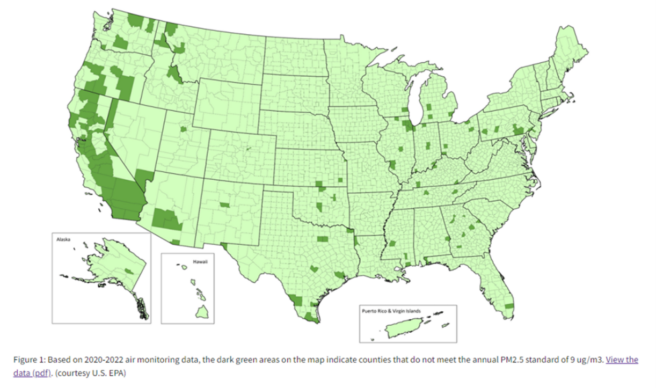
In Louisiana, Caddo Parish and West Baton Rouge Parish, with design values of 9.6 µg/m3 and 9.1 µg/m3, respectively, would not meet the PM2.5 NAAQS of 9 µg/m3. However, Louisiana’s Department of Environmental Quality has submitted two “exceptional event”1 demonstrations to the EPA for consideration, both dealing with the Port Allen monitoring station in West Baton Rouge Parish. The events included a Saharan Dust that resulted in 5 days of elevated PM2.5 levels in June 2022 and a Canadian Wildfire Smoke that resulted in 2 days of PM2.5 exceedances in October 2023. Removal of these “exceptional events” would result in West Baton Rouge Parish meeting the PM2.5 NAAQS of 9 µg/m3.
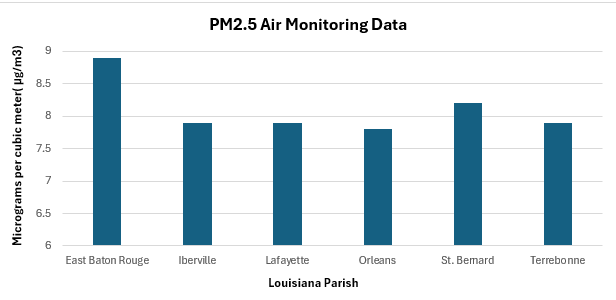
In addition to the areas that would likely be in non-attainment, there are also numerous areas that would be very close to exceeding the standard, which would severely limit growth and development in those areas. In Louisiana specifically, the following parishes have design values that are approaching the 9 µg/m3 standard:
Litigation Challenging Final Rule Tightening PM2.5 NAAQS
OnMarch 6, 2024, a group of states, including Louisiana, and other industry groups filed petitions for judicial review in the D.C. Circuit, requesting the court to vacate EPA’s rule tightening the PM2.5 NAAQS. See Commonwealth of Kentucky et al. v. EPA et al., No. 24-1050 (D.C. Cir. Mar. 6, 2024). The industry groups and states claimed that EPA acted in a manner contrary to law by improperly undertaking a discretionary, non-statutory reconsideration of the PM2.5 NAAQS, rather than a statutorily-mandated review under CAA § 109(d) (i.e., five-year review), and failing to adequately consider all required and relevant factors, including costs, in making its decision. Oral argument was held on December 16, 2024. Most recently, on February 25, 2025, the D.C. Circuit granted EPA’s motion to hold the case in abeyance for 60 days to allow new EPA leadership to review the PM2.5 NAAQS.
Reconsideration of PM2.5 NAAQS
In connection with the agency’s March 12, 2025, announcement to reconsider the PM2.5 NAAQS, EPA Administrator Zeldin noted that the previous administration’s PM2.5 NAAQS raised serious concerns from states and served as a major obstacle to permitting. “Under President Trump, we will ensure air quality standards for particulate matter are protective of human health and the environment while we unleash the Golden Age of American prosperity,” said Zeldin. It is important to note that any attempt by EPA to revise the previous administration’s PM2.5 NAAQS will be subject to the formal rulemaking process, including notice and comment periods.
In addition to a reconsideration of the PM2.5 NAAQS, EPA announced that “it will soon release guidance to increase flexibility on NAAQS implementation, reforms to New Source Review, and direction on permitting obligations.”
Stay tuned for further developments. Liskow will be monitoring and covering further actions regarding the new administration’s reconsideration of the PM2.5 NAAQS on Liskow’s The Louisiana Industrial Insights Hub. For more information on industry impacts and opportunities arising under the new administration, please contact Liskow attorneys Greg Johnson, Clare Bienvenu, and Colin North.
1One of EPA’s 31 historic deregulatory actions includes a reconsideration of its Exceptional Events Rule.