
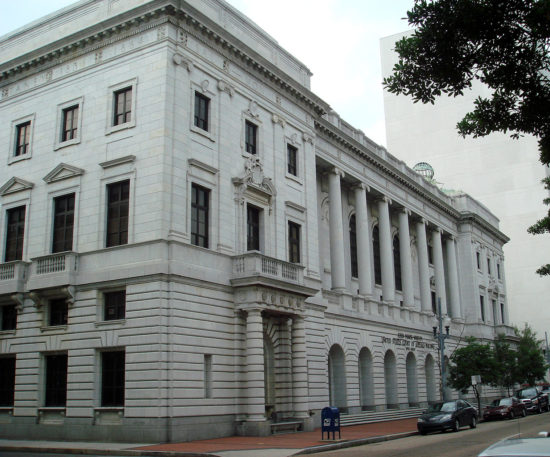
Today, the United States Court of Appeals for the Fifth Circuit affirmed the Eastern District’s exercise of jurisdiction and dismissal on the merits of a headline-grabbing environmental law tort suit against 97 oil and gas companies, seeking to hold those entities responsible for Louisiana’s coastal erosion.
Background
More than three years ago, the Southeast Louisiana Flood Protection Authority–East, a local levee board with flood protection jurisdiction in Orleans, Jefferson, and St. Bernard Parishes, sued 97 oil and gas companies in the Civil District Court for Orleans Parish. The suit attracted national attention, alleging that past and present operations of the oil and gas industry—most specifically, dredging of canals—contributed to land loss on a massive scale and rendered defendants liable for billions in damages and restoration costs.
The defendants removed the case to federal court, and, after a protracted jurisdictional battle, defeated SLFPA-E’s attempt to return the case to state court. Judge Nannette Jolivette Brown denied remand on the basis of federal question jurisdiction, finding that SLFPA-E’s allegations raised substantial, disputed questions of federal law.
The defendants thereafter filed a host of motions to dismiss the case on the merits, including a Motion to Dismiss for failure to state a claim. On February 13, 2015, Judge Brown granted that motion, finding in a detailed opinion that SLFPA-E’s tort claims were without merit because the defendants did not owe any duty to the plaintiff under Louisiana law. Judge Brown did not take up the defendants’ other motions.
SLFPA-E appealed, arguing heavily against Judge Brown’s initial decision to exercise federal jurisdiction.
The Fifth Circuit’s Decision
In a unanimous decision, the Fifth Circuit affirmed Judge Brown’s exercise of jurisdiction and dismissal on the merits. The opinion finds that the district court correctly concluded that SLFPA-E’s state law tort claims raised federal issues insofar as each claim drew upon federal laws (the Rivers and Harbors Act and the Clean Water Act) to ostensibly create the requisite standard of care forming the basis of the SLFPA-E’s negligence claim.
The court noted: “[SLFPA-E’s] negligence and nuisance claims cannot be resolved without a determination whether multiple federal statutes create a duty of care that does not otherwise exist under state law.” Moreover, the court recognized that this was a “substantial” dispute over federal law to justify this limited exception to the exercise of federal jurisdiction over state law tort claims because “the dispute between the parties does not just concern whether defendants breached duties created by federal law; it concerns whether federal law creates such duties.”
The court recognized that in determining whether such duties exist, Louisiana courts consider whether there is an ease of association between the plaintiff’s harm and a defendant’s conduct. The court then affirmed dismissal of SLFPA-E’s negligence and strict liability tort claims on the basis that defendants owed no duty to this particular plaintiff under the Louisiana test.
SLFPA-E’s attenuated theory of recovery was essentially that land loss reduced the “buffer” between New Orleans and other areas in SLFPA-E’s jurisdiction, allowing storms to come ashore with more ferocity, which, in turn, places a greater strain on the levee systems for which SLFPA-E is responsible.
The court determined that neither federal law nor Louisiana law creates a duty for oil and gas companies to protect SLFPA-E from increased flood protection costs arising out of the damage allegedly caused by the defendants. In other words, the principal purpose of the Clean Water Act and the Rivers and Harbors Act was not to protect a local levee board. The court affirmed dismissal of the Board’s other state law claims (that defendants had impaired the “natural servitude of drain” under the Louisiana Civil Code, on the basis that the board did not establish that it owned a servient estate; and nuisance, on the basis that the Board did not sufficiently allege in its complaint that it is a “neighbor” of any of defendants’ property).
Throughout this contentious, politically charged lawsuit’s history, its advocates have urged that the validity of SLFPA-E’s claims should be decided by the courts. Two federal courts have now unanimously rejected those claims.
Disclaimer: This Blog/Web Site is made available by the law firm of Liskow & Lewis, APLC (“Liskow & Lewis”) and the individual Liskow & Lewis lawyers posting to this site for educational purposes and to give you general information and a general understanding of the law only, not to provide specific legal advice as to an identified problem or issue. By using this blog site you understand and acknowledge that there is no attorney client relationship formed between you and Liskow & Lewis and/or the individual Liskow & Lewis lawyers posting to this site by virtue of your using this site. The Blog/Web Site should not be used as a substitute for legal advice from a licensed professional attorney in your state regarding a particular matter.