

The pursuit of alternative energy sources has become increasingly important in our quest for a sustainable future. Lithium, a key component in rechargeable batteries, has emerged as a vital element for powering electric vehicles and storing renewable energy. The rising demand for lithium, combined with Federal tax credits for lithium production, has intensified lithium exploration efforts. At the forefront of these efforts lies the Smackover Formation, pictured below:
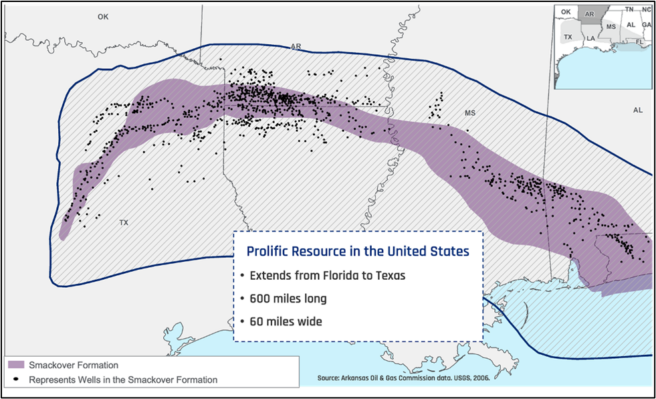
The Smackover Formation is a limestone aquifer that spans across several states in the southern United States, including Arkansas, Louisiana, Mississippi, and Alabama. Formed during the Jurassic period, this geological formation has been tapped for oil and gas, as well as brine for production of bromine, since the 1950s. Recently, several operators have started pilot projects to produce lithium from Smackover brine as well.
The high concentration of lithium in Smackover brines presents a unique opportunity to produce lithium through direct extraction. Currently, large-scale lithium production from brine is done using evaporation ponds, which is costly and takes a considerable amount of time. New advancements in chemical and mechanical extraction techniques have made it possible to separate lithium from brine much more quickly and with lower ecological impact. The high lithium concentration in Smackover brines makes this formation the perfect target for operators looking to scale up these newer methods.

Another notable aspect of the Smackover Formation is its extensive coverage—ranging from Texas to Florida—and its considerable thickness. This widespread distribution makes it an attractive target for lithium exploration and production. Furthermore, the formation’s depth and accessibility make it economically viable for extraction operations.
A brine extraction prospect would be very similar to an oil and gas prospect. Like an oil and gas prospect, the first step is to acquire the necessary legal rights to drill for and produce the brine. Any existing mineral grants, servitudes, or leases must be examined to determine if the language of the deed is broad enough to cover brine. If a new lease is entered into, the procedure for payment to the lithium rights owner must be thoughtfully created. Once the brine is brought to the surface, it undergoes the direct extraction process and then the remaining brine, sans the lithium, is injected back into the producing formation. A Class V injection permit, either from the EPA or a state with an approved program, must be obtained to inject the processed brine.
The law on these issues is in its infancy in most States, with the exception of Arkansas. High bromine concentrations were discovered in Arkansas brine decades ago, which has given rise to a well-developed body of legislation and jurisprudence over the production, processing, and injection of brine in that State. Of particular note is Arkansas’s unique payment structure for bromine production; rather than paying a royalty based on a percentage value for the brine or bromine, producers essentially pay a flat rental per acre to the landowners. The development of brine law in Arkansas should be studied by operators and legislators alike who are looking to capitalize on lithium extraction in their own States.
In conclusion, the Smackover Formation represents a promising frontier in the quest for lithium production. Its extensive coverage, considerable thickness, and direct extraction potential make it an attractive resource for meeting the growing demand for lithium. However, outside of Arkansas, there is great uncertainty regarding the legal rights and regulatory framework for this new industry. Thus, for prospective lithium producers and the States where they operate, clearing up these uncertainties will be a first priority.
Disclaimer: This Blog/Web Site is made available by the law firm of Liskow & Lewis, APLC (“Liskow & Lewis”) and the individual Liskow & Lewis lawyers posting to this site for educational purposes and to give you general information and a general understanding of the law only, not to provide specific legal advice as to an identified problem or issue. By using this blog site you understand and acknowledge that there is no attorney-client relationship formed between you and Liskow & Lewis and/or the individual Liskow & Lewis lawyers posting to this site by virtue of your using this site. The Blog/Web Site should not be used as a substitute for legal advice from a licensed professional attorney in your state regarding a particular matter.
Privacy Policy: By subscribing to Liskow & Lewis’ E-Communications, you will receive articles and blogs with insight and analysis of legal issues that may impact your industry. Communications include firm news, insights, and events. To receive information from Liskow & Lewis, your information will be kept in a secured contact database. If at any time you would like to unsubscribe, please use the link located at the bottom of every email that you receive.