
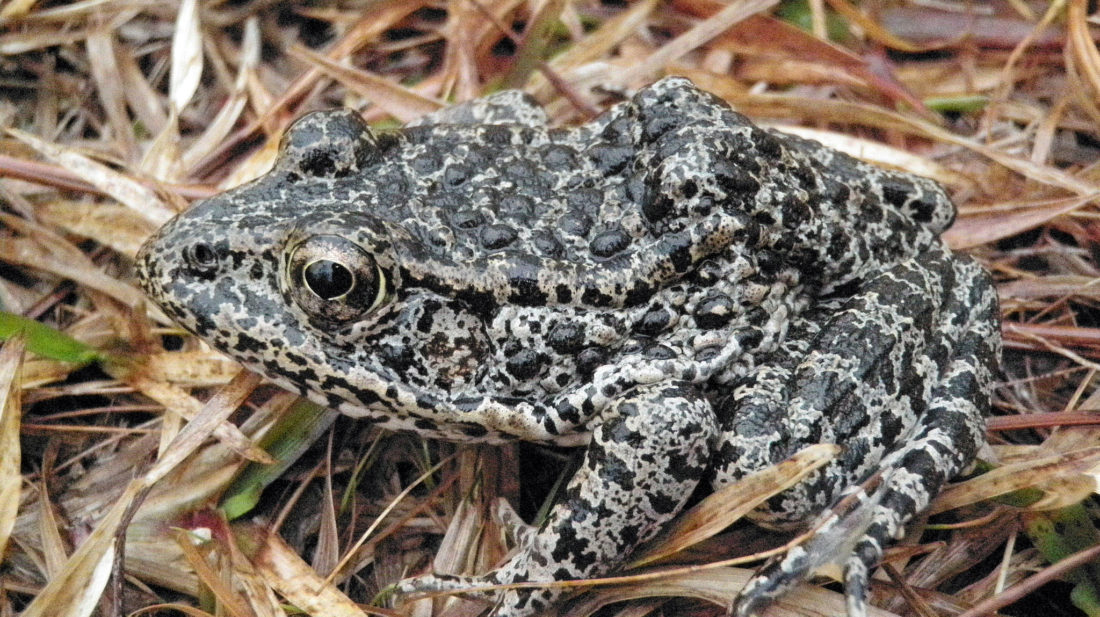
A group of Louisiana landowners, Weyerhaeuser Company, and the Pacific Legal Foundation filed Petitions for Writs of Certiorari this month asking the U.S. Supreme Court to overturn the U.S. Fish and Wildlife Service’s (USFWS) decision to designate 1,544 acres of private land in St. Tammany Parish, Louisiana as critical habitat for the endangered dusky gopher frog.
Petitioners’ primary points of contention are that the property has not been inhabited by dusky gopher frogs since the 1960s and, although the land was historically a breeding ground for the frogs, the property now lacks certain habitat features, including an herbaceous undergrowth and an open forest canopy, necessary for the species to survive there. Property modifications, including altering the present timber management practices, could return the land to suitable frog habitat but the landowners do not intent to take these steps and the government concedes it cannot compel them to do so. The critical habitat designation may, however, limit the landowners’ development of the property as federal permits and USFWS consultation will be required for work in the property’s wetland areas. The Petition for Writ of Certiorari complains that:
The government designated over 1,500 acres of private land as critical habitat for the dusky gopher that is not used or occupied by the species; is not near areas inhabited by the species; is not accessible to the species; and, does not support the existence or conservation of the species in any way. Yet, the designation may cost the landowners up to $34 million in lost value.
The lower courts previously rejected the landowners’ arguments. (A prior article discussing the Fifth Circuit holding is available here and a prior article discussing the Fifth Circuit’s denial of an en banc rehearing is available here). The USFWS’ critical habitat designation was upheld by Judge Feldman in the Eastern District of Louisiana in 2014, affirmed by a 2-1 decision in the Fifth Circuit Court of Appeals in 2016, and denied an en banc rehearing by an 8-6 vote of the Fifth Circuit in February 2017. But the frog’s case has proven to have legs and may endure longer than the species itself.
The dusky gopher frog, Rana sevosa, was once abundant across Louisiana, Mississippi, and Alabama. The frog dwells in underground burrows, breeds in ephemeral ponds, and is endemic to the longleaf pine forests located in the coastal plains of the region. As 95% of the longleaf pine forest habitat has disappeared, so too have the frogs, which were last observed in Louisiana in 1965. Currently, the entire population of dusky gopher frogs is estimated to be fewer than 150 adults and the species’ current range is limited to three ponds in south Mississippi.
In 2001, the USFWS listed the dusky gopher frog as an endangered species. In July 2012, the USFWS designated 6,477 acres as federal, state, and private lands as critical habitat for the species, including the subject 1,544 acres of private land in St. Tammany Parish, Louisiana. The Endangered Species Act (16 U.S.C. § 1531 et seq.) authorizes the USFWS to designate “unoccupied” habitat as critical if “a designation limited to the present range would not be adequate to ensure the conservation of the species” and the USFWS determines that the land is “essential for the conservation of the species.” Petitioners and the USFWS dispute whether “essential” land must also be “habitable.” The USFWS argued in the lower courts that the designation of the subject private property (Unit 1) passed muster under the statute, contending:
The final June 2012 Rule designated 6,477 acres in Mississippi and Louisiana, 5,281 acres of which is unoccupied habitat, including the 1,544 acres in Unit 1 which FWS considers to be, in its totality, the highest quality breeding habitat anywhere in the frog’s [historic] range…. After considering the best available science, including the input of six experts, and the importance of ephemeral ponds to the recovery of the frog, FWS reasonably determined that Unit 1 is essential for the conservation of the species.
After each of the lower court’s affirmed the USFWS’ designation, Petitioners sought relief in the Supreme Court arguing, in pertinent part, that: (1) the USFWS acted arbitrarily and capriciously when it designated as critical habitat private property that, absent modification which the agency cannot compel landowners to perform, is uninhabitable by the listed species; (2) designation of critical habitat not presently occupied by the listed species should require greater scrutiny than designation of critical habitat currently occupied by the species; (3) the alleged failure to exclude the critical habitat due to economic consideration should be judicially reviewable for an abuse of discretion under the Administrative Procedure Act; and (4) the critical habitat designation impinged on the powers of the State in violation of the Tenth Amendment. (A copy of the petition filed by The Pacific Legal Foundation is available here) Responses to the petitions are due by August 14, 2017.
This case may open the door for the Supreme Court to revisit the Chevron deference principle established in a landmark 1984 case that held courts should defer to an agency’s interpretation of a federal law that contains ambiguous language unless the agency’s interpretation is unreasonable. Justice Neil Gorsuch, President Trump’s appointee and the newest member of the high court, is a noted Chevron deference skeptic who has referred to the principle as “a judge-made doctrine for the abdication of the judicial duty.” It remains to be seen whether the addition of Justice Gorsuch will impact the Court’s consideration of this case. Four affirmative votes are needed for the case to come before the Court.
Disclaimer: This Blog/Web Site is made available by the law firm of Liskow & Lewis, APLC (“Liskow & Lewis”) and the individual Liskow & Lewis lawyers posting to this site for educational purposes and to give you general information and a general understanding of the law only, not to provide specific legal advice as to an identified problem or issue. By using this blog site you understand and acknowledge that there is no attorney client relationship formed between you and Liskow & Lewis and/or the individual Liskow & Lewis lawyers posting to this site by virtue of your using this site. The Blog/Web Site should not be used as a substitute for legal advice from a licensed professional attorney in your state regarding a particular matter.