
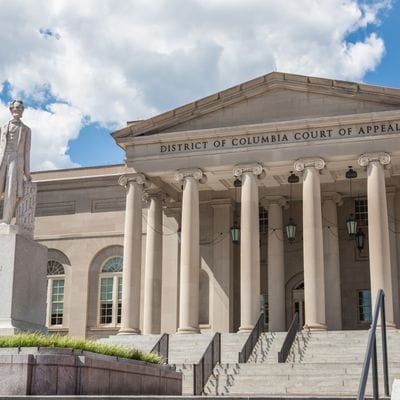
On July 28, 2026, the United States Court of Appeals for the District of Columbia Circuit (D.C. Circuit) upheld the first Trump EPA’s “project emissions accounting” rule (or the Rule), which allows air permit applicants to account for both emissions increases and decreases at the first stage of New Source Review (NSR). Environmental Defense Fund v. EPA, No. 18-1149. The D.C. Circuit’s decision comes on the heels of several significant NSR developments, including EPA’s reinstatement of its “no-second guessing” policy, recission of its reactivation policy, and promulgation of its proposed rule clarifying the scope of construction activities that may proceed without obtaining an NSR permit.
EPA’s “Project Emissions Accounting” Rule
Under the Clean Air Act’s NSR program, an existing major stationary source proposing to undertake a project must determine whether such project will constitute a “major modification” subject to the major NSR preconstruction permitting requirements by following a two-step applicability test:
- At Step One, the regulated entity and permitting authority ask whether the proposed project would, by itself, cause a “significant emissions increase” of a regulated NSR pollutant; if it would not, the project does not constitute a modification, and no major NSR permit is required.
- If the proposed project will itself significantly increase emissions of a regulated NSR pollutant, the regulated entity and permitting authority move to Step Two and determine whether the project will also result in a “significant net emissions increase” (i.e., whether it will be offset by a source-wide emissions decrease, which must be creditable and contemporaneous with the corresponding emissions increase).
In 2020, EPA finalized the project emissions accounting rule to clarify that both increases and decreases in emissions resulting from a proposed project can be considered in Step One of the NSR major modification applicability test.
Petitioners’ Challenge
Petitioners claimed that the Rule was contrary to law and arbitrary or capricious, in part because measuring net emissions on a project-by-project basis (as opposed to a source-wide basis) “invites entities to circumvent NSR review by bundling ‘unrelated activities’ into a single ‘project.’” That flaw, the petitioners argued, “was enabled and exacerbated, by the EPA’s decision not to import Step Two’s guardrails—namely, creditability and contemporaneity—into Step One.”
D.C. Circuit’s Decision
The D.C. Circuit ultimately rejected the petitioners’ arguments because it concluded that the Clean Air Act did not preclude EPA’s interpretation allowing project-related emissions decreases to be considered alongside increases at Step One. The D.C. Circuit did, however, note that the petitioners had identified circumstances which could preclude certain applications of the Rule.
Prior precedent established that, when calculating net emissions increases, any emissions decrease must be “substantially contemporaneous” with the emissions increase. Because EPA’s Rule did not include a temporal boundary on the emissions decreases that may be considered, the D.C. Circuit explained that, depending on how the Rule is applied to particular projects, an application of the Rule might not satisfy the substantial contemporaneity requirement. However, the D.C. Circuit held that the project emissions accounting rule was not facially unlawful and would “reserve questions regarding the Rule’s particular applications for another day.”
This decision confirms EPA’s authority to evaluate a project’s net emission effects at the first step of the NSR applicability analysis and provides continued regulatory certainty for facilities undertaking modernization and operational improvement projects. For certain projects, the ability to account for emissions decreased alongside increases at Step One may allow facilities to avoid triggering major NSR permitting requirements. However, facilities should continue to evaluate whether emissions decreases satisfy applicable timing and creditability requirements.
For further information on air permitting requirements for construction, please contact Greg Johnson, Clare Bienvenu, Emily von Qualen, or Colin North.
The Environmental Defense Fund and several other environmental
groups have petitioned for review of a rule that alters the
Environmental Protection Agency’s process to determine
whether a stationary source of air pollution can be modified
absent a permit under the Clean Air Act’s New Source Review
program. The petitioners have not persuaded us that the rule is
contrary to law. Nor have they demonstrated that it is arbitrary
or capricious. Accordingly, we deny their petitions.