
/Passle/6862a7c82f493872278415a8/MediaLibrary/Images/2026-02-20-14-36-48-245-69987180b51a6f81f2ead8bc.jpg)
On May 9, 2025, the Trump Administration published an executive order (“EO”), titled “Fighting Overcriminalization in Federal Regulations,” that targets criminal regulatory offenses subject to strict liability, or liability that attaches without a required criminal mindset. The EO states that strict liability offenses are “generally disfavored,” and encourages agencies to consider civil or administrative, rather than criminal, enforcement of strict liability offenses. The EO further explains that prosecution of criminal regulatory offenses is “most appropriate” when “a putative defendant is alleged to have known his conduct was unlawful.”
Typically, criminal conduct is accompanied by some sort of culpable mindset—the conduct needs to be intentional, willful, reckless, or knowing to be criminal conduct. But, certain federal statutes, notably in the environmental context, can be interpreted to make some actions criminal even where they lack a traditional criminal mental state, imposing “strict” criminal liability or criminal liability for simple negligence. Strict liability environmental crimes, coupled with the explosion of environmental criminal investigators mandated by the Pollution Prosecution Act of 1990, resulted in a striking increase in environmental criminal prosecutions under certain administrations. The absence of a required mental state for certain violations to be pursued criminally left prosecutorial discretion as the primary determinant of which violations were serious enough to investigate criminally and that discretion has varied across administrations and even individual prosecutors over time.
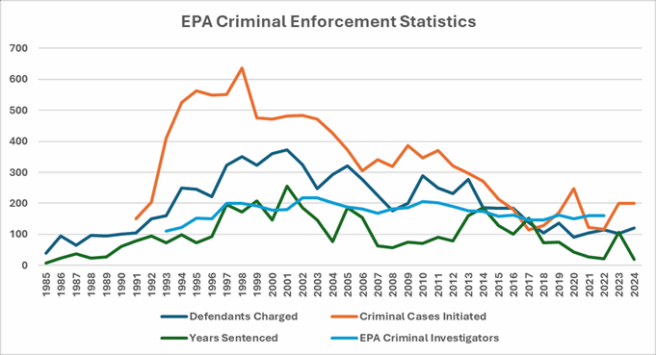
The EO seeks to both clarify the standard by which this administration chooses to evaluate potentially criminal conduct and to homogenize the prosecutorial decisions.
Agencies Must Be Clear About Required Criminal Intent in New Regulations and Must Designate the Required Mental State for Existing Criminal Offenses
The EO notes that, going forward, agencies promulgating regulations subject to criminal enforcement should describe the exact conduct susceptible to criminal enforcement, the authorizing statutes, and the requisite knowledge or intent applicable to those offenses. That is, any new rule established by an agency that may be criminally enforced requires the agency to expressly disclose that a violation of the rule may constitute a criminal regulatory offense and should state the requisite mindset for each element of the offense.
Within a year from May 9, 2025, agencies must issue a report to the Office of Management and Budget (“OMB”) containing a list of existing enforceable criminal regulatory offenses that explains the possible penalties for said offenses as well as the applicable mindset or knowledge needed to commit them. This report will be posted to the agency’s webpage and updated at least once a year. If an offense is not mentioned in the report, the agency is “strongly discouraged” from imposing criminal penalties. The agency must consider if an offense is in its report before making a criminal referral, and the attorney general must consider this before initiating a criminal investigation or criminal proceedings. Also, the EO requires agencies to review their existing regulations to assess whether the applicable mental state requirements for criminal regulatory offenses are appropriate, which must be done by report within 30 days after submitting the original OMB report. This second report should present a plan, if consistent with the agency’s statutory authority, to adopt a “generally applicable” mental state requirement that applies unless a specific regulation states an alternative requirement.
Lastly, after consulting with the attorney general, agencies must publish guidance in the Federal Register expressing their plan to address criminally enforceable offenses. The EO requires each agency publishing guidance to make clear that it will consider the following when deciding whether to refer alleged violations of criminal regulatory offenses to the Department of Justice: the risk of harm caused by the offense; the potential gain for the person committing the offense; whether the person committing the offense had knowledge or expertise of the regulation at issue; and any evidence of the alleged perpetrator’s general awareness of the unlawfulness of his conduct and if he had knowledge of the regulation itself. The EO criticizes the large number of regulatory crimes that are strict liability offenses, noting that likely not even “those charged with enforcing our criminal laws at the Department of Justice … know[] how many separate criminal offenses are contained in the Code of Federal Regulations[.]” The EO then presents the issue with this framework by explaining that it is an “absurd and unjust” concept that permits the “weaponization” of these regulatory offenses by government officials. Accordingly, the EO establishes a clear directive in response: “Criminal enforcement of criminal regulatory offenses is disfavored” and “is most appropriate for persons who know or can be presumed to know what is prohibited or required by the regulation and willingly choose not to comply.” This directive demonstrates a notable change in direction that the current administration is taking with respect to criminal enforcement of regulatory offenses, and the regulated community should stay tuned for further updates on this topic.
For further questions regarding this topic, contact Liskow attorneys Greg Johnson, Clare Bienvenu, Sean Toomey, and Colin North, and visit the Louisiana Industrial Insights Hub for further updates.